

Discovering a fulfilling second career is exhilarating

The following is an original article by Julie Morris, of www.juliemorris.org, who is solely responsible for the contents of her article.
People in their 60s often sit on something far more valuable than startup funding: decades of experience. That experience includes technical skills, hard-earned judgment, pattern recognition, and a deep understanding of how people and organizations actually work. The question is not whether you have value to offer — it’s how to turn that value into a practical, sustainable business that fits this stage of life.
A Quick Overview
If you remember nothing else, remember this:
- Start with what you already know and have done repeatedly.
- Package it into a small, low-risk offer.
- Test demand before investing heavily.
- Design the business around your energy, not the other way around.
- Build something that supports your lifestyle and long-term goals.
This is not about building a unicorn startup. It’s about building something steady, meaningful, and aligned.
Step 1: Identify Your Marketable Experience
You don’t need a brand-new idea. You need clarity.
Think in terms of problems you’ve solved, not job titles you’ve held.
A simple inventory exercise
Ask yourself:
- What do people regularly ask me for help with?
- What problems have I solved over and over again?
- What results have I consistently delivered?
- What mistakes have I learned to avoid?
Write down concrete examples. “Managed teams” is vague. “Helped underperforming teams improve productivity within six months” is specific and marketable.
Now look for patterns. Maybe you’ve:
- Guided employees through career transitions
- Helped small businesses stabilize cash flow
- Trained staff on compliance or safety
- Led complex projects across departments
These patterns point to services people will pay for.

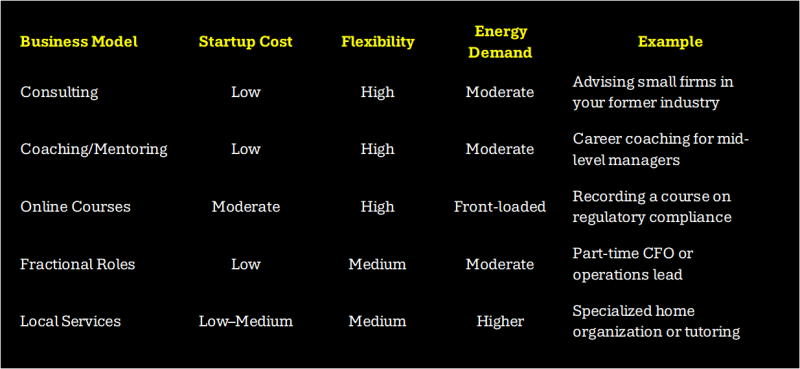

Step 2: Choose a Low-Risk Starting Model
At this stage of life, risk tolerance often changes. You may have retirement savings to protect or a desire for flexibility rather than scale-at-all-costs growth.
Step 3: Validate Before You Commit
Too many second-career entrepreneurs overbuild before confirming interest.
Here’s a practical validation checklist:
- Define one clear problem you solve.
- Describe the specific outcome clients get.
- Create a short description of your offer (one paragraph).
- Share it with 10–20 people in your network.
- Ask: “Would this be useful to you or someone you know?”
- If three to five people express real interest — especially if someone offers to pay — you have a signal.
You can also:
- Run a small paid pilot program.
- Offer a discounted “beta” version of your service.
- Conduct informal interviews with potential clients.
Validation reduces financial and emotional risk.
Understanding the Different Challenges at This Stage
Starting a business in your 60s is not the same as launching one at 28. Priorities shift. You may care more about meaningful work and flexibility than rapid growth. Financial considerations often revolve around protecting retirement income, not reinvesting every dollar.
Confidence can also be complicated. On one hand, you have decades of expertise. On the other, you may question whether the market still values it.
Understanding workforce trends and common barriers can help you make clearer decisions. Research from organizations that study career transitions and labor shifts shows that later-career professionals often face different obstacles — but also bring unique advantages. For example, insights from a career-focused research institute that analyzes workforce patterns and career mobility can offer helpful perspectives; if you’re exploring this path, you may want to check this out.
Seeing the broader picture can replace uncertainty with strategy.
Step 4: Leverage Existing Networks
In your 60s, your network is one of your strongest assets.
Instead of cold marketing, start with:
- Former colleagues
- Industry peers
- Professional associations
- Community groups
- LinkedIn connections
Reach out personally. Let people know what you’re offering and who it’s for. Be specific. “I’m now helping small manufacturers improve inventory control systems” is stronger than “I’ve started consulting.”
Referrals often come from people who already trust you.
Design Around Energy, Not Ego
Energy management is a real-world constraint. You may not want 60-hour weeks or constant travel.
Ask:
- How many hours per week do I want to work?
- Do I prefer remote, in-person, or hybrid?
- Do I want seasonal bursts of work or steady monthly income?
A sustainable business in your 60s often looks like:
- 10–25 billable hours per week
- Recurring monthly clients
- Clear boundaries on availability
- Predictable income targets
There is no prize for burnout.


Frequently Asked Questions
Is it too late to start a business in my 60s?
No. Many successful businesses are started by people over 50 or 60. Experience, credibility, and networks often shorten the path to paying clients.
What if I’m not tech-savvy?
You don’t need to master everything. Basic digital skills (email, video calls, simple invoicing) are usually enough. You can outsource website design or bookkeeping.
How do I protect my retirement savings?
Start small. Avoid large upfront investments. Fund the business from current income or a modest, predefined budget rather than dipping heavily into retirement accounts.
What if I’m unsure about demand?
Test before committing. Offer a pilot program or short-term engagement. Let real-world feedback guide expansion.
One Practical Resource for Small Business Starters
If you want grounded, step-by-step guidance on starting and managing a small business, the U.S. Small Business Administration offers free tools, planning templates, and local support networks.
Their materials cover business plans, financing basics, and legal considerations — all useful when turning experience into structure.
Conclusion
Your 60s can be a powerful time to build a business rooted in wisdom rather than hustle. The key is alignment: your experience, your lifestyle, and your long-term vision working together. A practical, steady business is not only possible — it may be the most strategic move you make at this stage of life.
Add comment
Comments